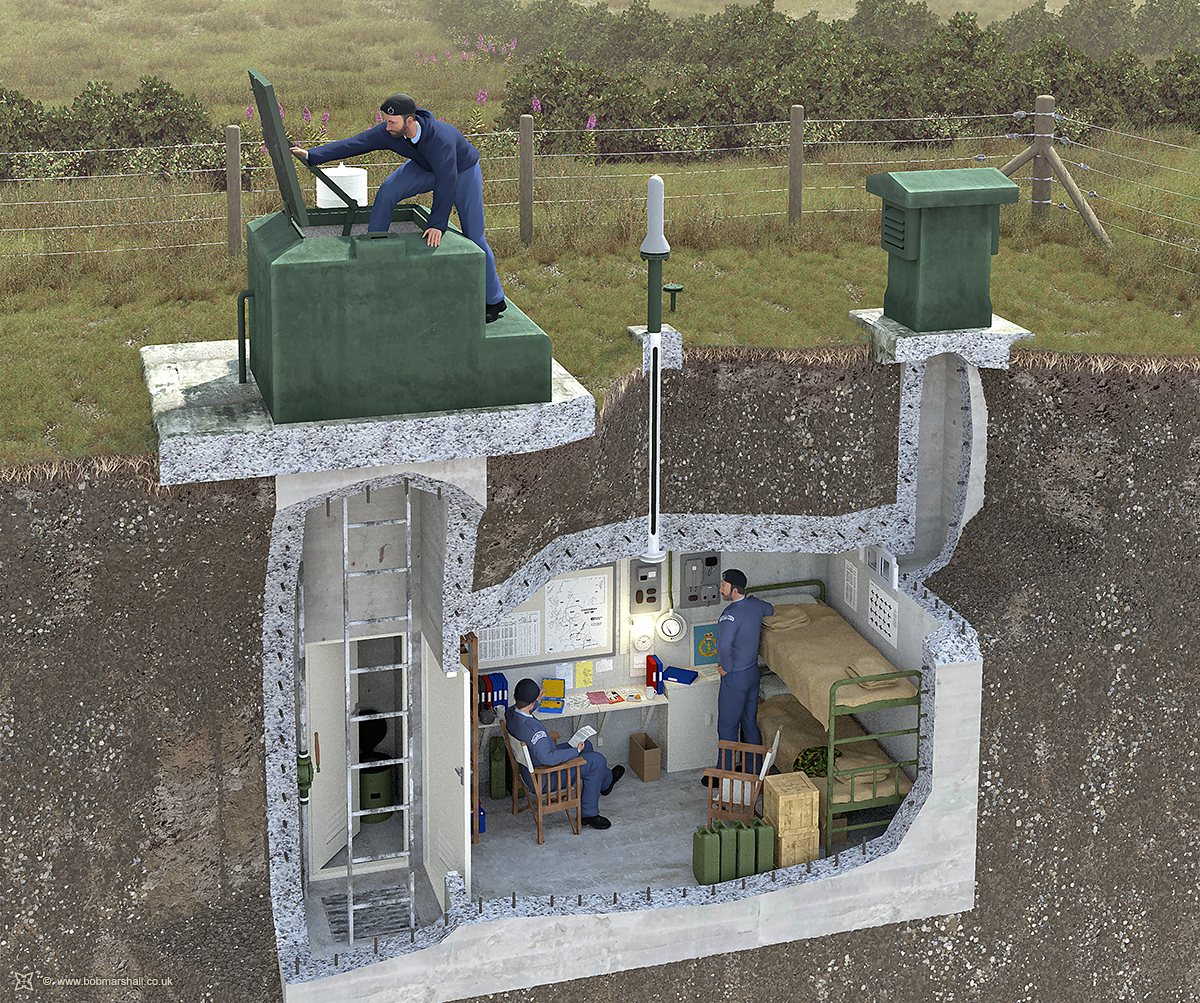
A cutaway reconstruction illustration of an underground Royal Observer Corps Monitoring Post used during the Cold War. Between 1955 and 1991, more than 1,500 of these underground facilities were located across the UK, roughly 10 miles apart, mainly in remote rural locations. They were of standard design and were constructed of 12-inch-thick steel-reinforced concrete, 20 feet beneath the ground. In the event of a nuclear attack, these posts would have been manned by members of the Royal Observer Corps. Their role would be to record details of a nuclear burst and relay them to UKWMO (United Kingdom Warning and Monitoring Organisation) Headquarters. Government and local authorities would then act on the information to determine the best way to protect civilian life. The ROC was stood down in 1991 following the end of the Cold War. About half of all ROC posts were demolished. The others remain in a derelict or abandoned state. Some have been preserved. The bunkers had no mains water, electricity, or heating. The only communication with the outside world was via a Tele-Talk system to headquarters and nearby ROC posts in the 'cluster group'. The master post in each cluster group was the only post equipped with radio communications as a backup.
How this image was made
Software and tools used: Blender 3D, Photoshop
Notes: A 3D model was used to create this cutaway illustration. This image was produced with the help and feedback of several former members of the Royal Observer Corps who staffed these bunkers in the late 1970s and early 1980s.
About the images in my portfolio
You may notice subtle shapes and patterns in some of the images in my online portfolio, affecting their visual quality. I am experimenting with free tools developed by researchers at the University of Chicago to help artists protect their work from unauthorised AI training. It subtly alters images in ways that are almost invisible to people but can confuse AI models, making it much harder for them to learn and reproduce an artist's distinctive style.
Personal Work
Artist:
Bob Marshall.May, 2015
Creative Commons CC BY-NC-ND 4.0. Reusers may copy and distribute the image in any medium or format. Credit must be given to the creator. Only non-commercial uses of the work are permitted. No derivatives or adaptations of the work are permitted.
My 3D models cannot be shared or licensed for other use due to contractual agreements with my clients and, in some cases, other stakeholders. More information can be found on my Licensing information page.