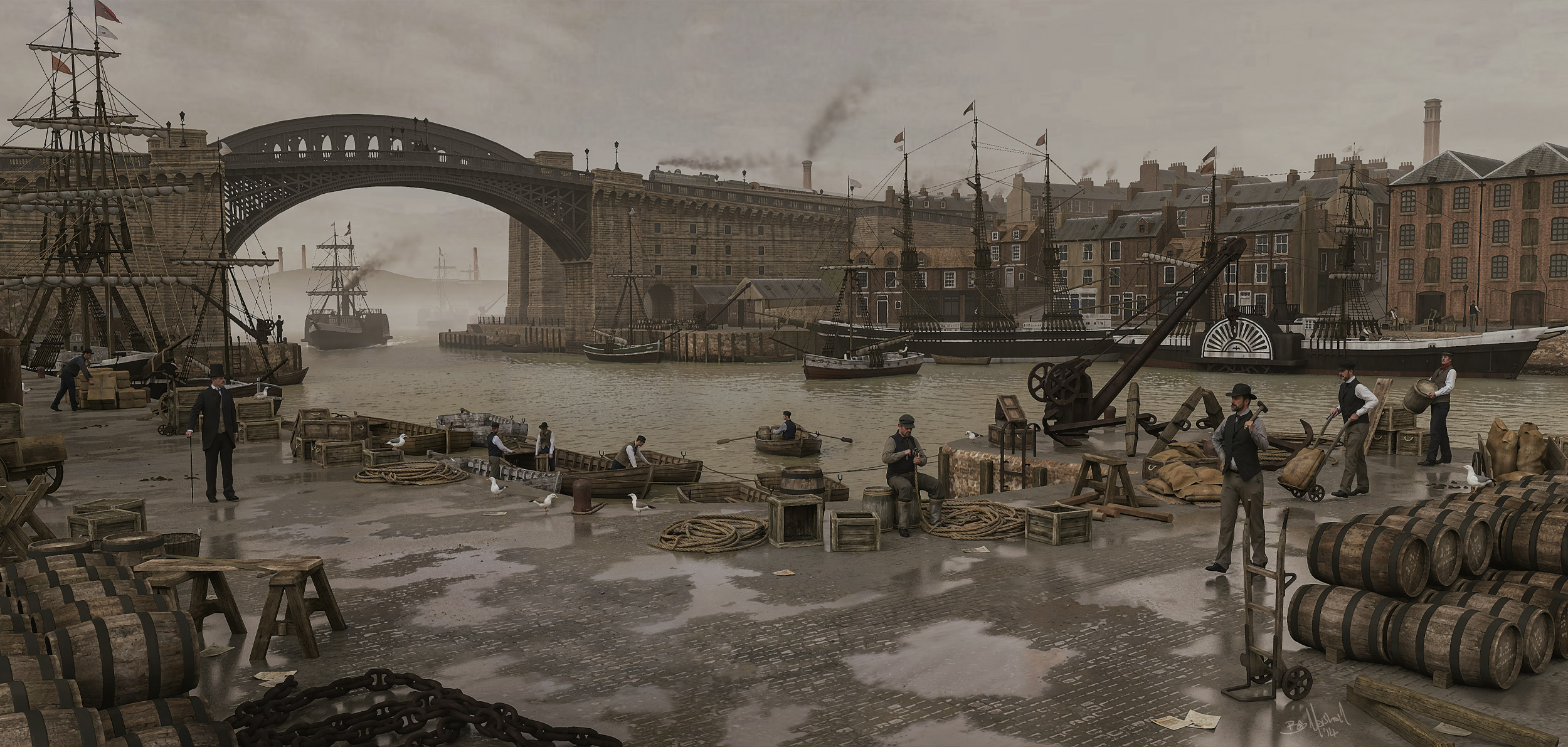
A digital reconstruction shows Pann’s Bank, Sunderland, as it might have looked in the 1800s. Shipbuilding has defined Sunderland since the 18th century. The industry’s roots go back to 1346, when merchant Thomas Menville established the first shipyard at Wearmouth. Demand for wooden ships soared during the Napoleonic Wars, and by 1814 the town boasted more than 20 active shipyards, 4 dry docks, 4 floating docks, and 5 boatbuilders’ workshops. Three shipyards lined the harbour’s south side, and two stood to the north. By 1840, Sunderland’s shipbuilding scene had expanded to 76 yards. Before the use of cast iron, bridges needed single spans so tall ships could pass beneath. As stone could not span the River Wear’s width, Hendon Dock Junction Bridge became the world’s first aluminium bascule bridge, a moveable structure counterbalanced by weights.
Sunderland’s industrial legacy also includes salt production. Beginning in 1589, seawater was boiled in large pans over coal fires, leaving behind salt crystals. This process, known as salt panning, gave the area between the city centre and the East End its name, Bishopwearmouth Panns Bank. The East End, once a place of intrigue and danger, resounded with the life of the docks. Smugglers, sailors, merchants, and even murderers mingled among the shipyards and alleys that shaped Sunderland’s colourful maritime past.
How this image was made
Software and tools used: Blender 3D, Photoshop
About the images in my portfolio
You may notice subtle shapes and patterns in some of the images in my online portfolio, affecting their visual quality. I am experimenting with free tools developed by researchers at the University of Chicago to help artists protect their work from unauthorised AI training. It subtly alters images in ways that are almost invisible to people but can confuse AI models, making it much harder for them to learn and reproduce an artist's distinctive style.
Commissioned Work
Artist:
Bob Marshall. 2014
Client:
Differentia Design
Image rights owner:
© Differentia Design
Please seek the permission of the owner to use or display this image elsewhere.
My 3D models cannot be shared or licensed for other use due to contractual agreements with my clients and, in some cases, other stakeholders. More information can be found on my Licensing information page.