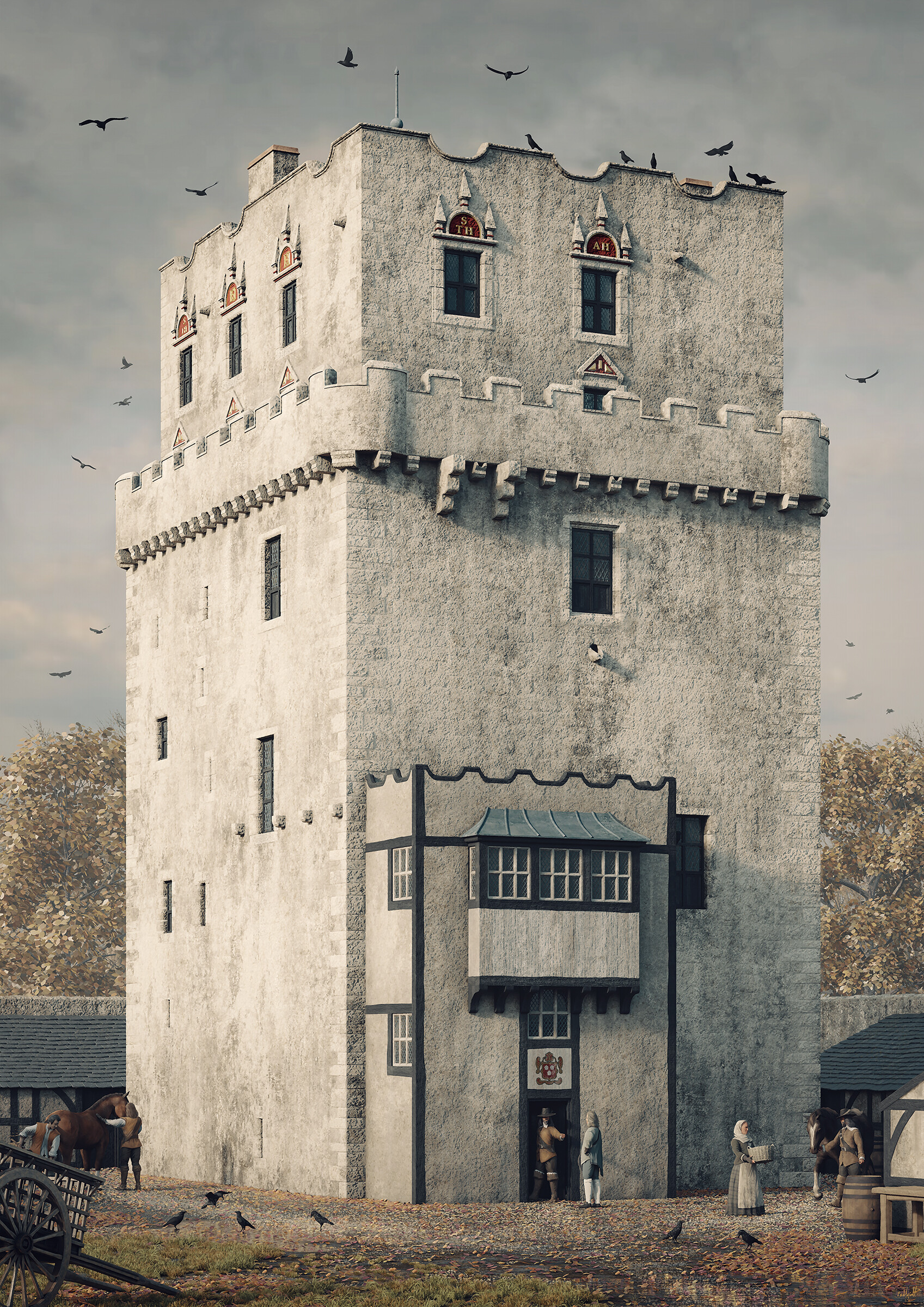
This is a digital reconstruction image of Preston Tower, East Lothian, showing how the tower may have looked in 1650, with two upper storeys added above the earlier tower's crenellated parapet. The upper-storey additions feature Jacobean-period architectural styles. The reconstruction shows a covered external timber forestair and a lime-rendered outer finish. The stairs provided access to the tower's first floor - a common means of entry to early medieval tower houses. By combining evidence from timber sockets visible in the exterior masonry with computer 3D models to explore different working configurations, this visual reconstruction suggests how it might have looked at the time, though this remains open to conjecture.
Constructed of red sandstone, the partially ruined L-plan tower house is notable for the rare addition of a Jacobean house built atop the original tower. The first tower was built by Sir Robert Hamilton, who inherited the estates in 1460. In 1626, two additional storeys were added above the parapet to feature windows bearing the initials of Sir John and Dame Katherine Hamilton. The tower was extensively damaged by fire three times throughout its history - deliberately by the Earl of Hertford under the orders of King Henry VIII in 1544, by Oliver Cromwell's army in 1650, and accidentally in 1663. After this, the Hamiltons abandoned the tower in favour of more comfortable accommodation at nearby Preston House. In 1969, the National Trust for Scotland purchased it, and it is now under the guardianship of East Lothian Council.
The community of Prestonpans has worked with local authorities, archaeological teams, and award-winning architects, Groves-Raines Architects Studio (GRAS), to stabilise the ruin and improve visitor access. The castle was partially reopened to visitors at the end of 2024. A team of enthusiastic volunteers hopes to operate a series of public open days once a month, with more conservation work and events planned for the future.
How this image was made
Software and tools used: Blender 3D, Cycles Render Engine, Substance 3D Painter, Photoshop
Notes: The image was developed from a 3D model, which was guided by input and advice from archaeologist Piers Dixon. A photogrammetric survey of the exterior building fabric served as the principal reference for 3D modelling. The internal spaces were modelled using floor plans and photography; however, much of the building's internal fabric above the second floor level is missing, so some speculation was necessary. The reconstructions mainly focus on the tower. Originally, the tower would have been located within an enciente or enclosure containing other buildings; however, such evidence has long been lost.
About the images in my portfolio
You may notice subtle shapes and patterns in some of the images in my online portfolio, affecting their visual quality. I am experimenting with free tools developed by researchers at the University of Chicago to help artists protect their work from unauthorised AI training. It subtly alters images in ways that are almost invisible to people but can confuse AI models, making it much harder for them to learn and reproduce an artist's distinctive style.
Commissioned Work
Artist:
Bob Marshall. 2022
Project consultants:
Piers Dixon
Client:
Friends of Preston Tower
Image rights owner:
© Friends of Preston Tower
Please seek the permission of the owner to use or display this image elsewhere.
My 3D models cannot be shared or licensed for other use due to contractual agreements with my clients and, in some cases, other stakeholders. More information can be found on my Licensing information page.